Excerpts Written
by
Rick Brusca
about
Steinbeck & Ricketts & Hedgpeth & Beebe
and Their Association to the
Marine Biology and Natural History
of the
Sea of Cortez
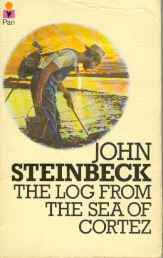
1960 Painting of 'Doc' Ricketts on Mud Flat
compiled by
Robert "Roy" J. van de Hoek
Vernal Equinox
Malibu, California
Richard Brusca, in his 1980 book shows us that marine biologists today are 'hitched' together socially and ecologically. From 1948, when Ricketts died, to 32 years later when the Brusca publishes his book with countless citations and references to Ricketts is incredible. In this case, Doctor Richard Brusca, a recognized expert on marine invertebrates, particularly the isopods, as well as the author of the most definitive book on marine life in Sea of Cortez, reflects on past naturalists of Steinbeck, Ricketts, Hedgpeth, and Beebe. There is a lineage and linkage of naturalists that spins off from former naturalists, not related by the amount of education at a University, but rather by the love of the seashore, natural history, and teaching about nature. The web page was created and compiled
to guide the curious individual into the realm of "knowledge is power" and "breaking through." "In the elders there is wisdom" is another phrase that could have been added, and now it is added, I suppose. There is something to be said for just plain pure education, knowledge, and curiosity to know
about natural landscapes from the perspective of WILD NATURE. It also hoped that this web page will help educate us all about the inter-relationships of the land and the sea, through the eyes of gifted marine naturalists. It is simply amazing to know that Richard Brusca has been influenced not only by Edward Ricketts, but also by Joel Hedgpeth, John Steinbeck, and William Beebe.
SELECTED WRITINGS EXCERPTED FROM RICHARD BRUSCA
in his book:
Common Intertidal Invertebrates of the Gulf of California University of Arizona Press, Tucson. 513pages
Excerpts from the Preface
"... Originally I had hoped for a handbook that would be something of a Hegelian combination of Light's Manualand Between Pacific Tides-the two great Pacific coast standards which introduced so many of us to the seashore. My thinking was also greatly influenced in early years by the mystique of Ed Ricketts, thte hegemonic polemics of Joel Hedgpeth, and the earlier writings of John Steinbeck..."
Excerpts from the Introduction
The dynamics of the tides have been amply explained in a great number of texts.... One of the most lucid accounts on the basics of this subject is Hedpeth's excellent description in Between Pacific Tides,pp.383-395.... E.F. Ricketts' original studies of intertidal zonation on the Pacific Coast of California recognized four zones or regions in the intertidal. Most students of the west coast have become so familiar with this scheme that its concept and practical application is almost subconsciously applied and rarely questioned. An excellent, firsthand discussion of this and other zonational schemes is give by Hedgpeth in Between Pacific Tides.
I have found Ricketts' time-proven scheme of intertidal zonation to work as well in the Gulf as it does elsewhere. The faunal and floral communities will of course vary in species names, but not in concept. Unlike Between Pacific Tides,the approach to this handbook is systematic.
Zones are designated as I, II, III, and IV and correspond somewhat to Ricketts' four zones for the California coast......The intertidal zone is, therefore, approximately 24 feet high, but may vary in width....
References to Steinbeck and Ricketts throughout the text refer to John Steinbeck and E.F. Ricketts, Sea of Cortez,Viking Press, New York, 1941. Anyone sincerely interested in the Gulf should have a copy of this remarkable book, a "leisurely journal of travel and research, with a scientific appendix on the marine animals of the Panamic Faunal Province." Unfortunately it is no longer in print, although most university libraries have copies.
Lastly, before progressing to the collecting and keying of the marine life of the Gulf, it becomes again necessary to remind everyone, students and teachers alike, of the growing need for conservation and ecology-conscious explorations of the seashore. Over the years, as interest in the sea has increased, so has an increased demand been placed on the intertidal habitat. The bus loads and vast car caravans of students that have been descending on the shores of California over the last 10 years have literally wiped out areas that once were nearly as productive as most of the Gulf of California still is. Thank Nature that the Gulf is protected by a factor of distance. In California places like Hazard Beach, Newport Bay, Dana Point, and the rocky coastline of the Santa Barbara region now harbor only the most common, drab, and fertile forms of marine life. Just 3 years ago the beautiful chestnut cowry (Cypraea spadicea),the only member of this tropical genus of shells known to occur north of Mexico on ouir coast, was so common at Dana Point that it could be picked up by the handfuls. Apparently it was. However, the Point's open, rocky coastline was also largely altered by a series of marinas. My last visit to Dana Point turned up but a single specimen of Cypraea. But, reminiscing does little good, for if there is one thing man learns from experience, it is the fact that man doesn't learn from experience. Needless to say, when you are exploring the vast virgin coastlines of the Sea of Cortez, take only what you need, return what you don't want (alive), and replace your overturned stones.
The author's most sincere gratitude and appreciation are extended to the scientists listed below, for without their cooperation and efforts this handbook could not have been prepared.... Dr. Joel W. Hedgpeth, Oregon State University Marine Science Center, for reviewing the introductory sections of the manuscript...
Excerpts from
From the Crustacea/Brachyura (Crab) Chapter
In spite of their numbers, these attractive crabs are very difficult to capture. John Steinbeck said of them in Sea of Cortez,"They seem to be able to run in any of four directions; but more than this, perhaps because of their rapid reaction time, they appear to read the mind of their hunter. They escape the long-handled net, anticipating from what direction it is coming. If you walk slowly, they move slowly ahead of you in droves. If you hurry, they hurry. When you plunge at them, they seem to disappear in little puffs of blue smoke ... It is impossible to creep up on them. Man reacts peculiarly but consistently in his relationship with Sally Lightfoot. His tendency eventually is to scream curses, to hurl himself at them, and to come up foaming with rage and bruised all over his chest."
Had Mr. Steinbeck done his collecting during the dark of the night, he may have had better luck with Miss Lightfoot, for these crabs occasionally "sleep" on the rocks well above the water line, often becoming so inactive they can be picked up by hand. Yet their antics prompted Hans Sloan, as long ago as 1725, to christen the Jamaican members of this species "Mardi Gras" (Natural History of Jamaica). One of the most colorful accounts of these acrobats I have read can be found in Boone (1927). A passage from William Beebe's Galapagos-World's Endbrings tears of joy to many a marine biologist: "Lying flat on the gentle slope of a huge cube, twenty feet each way, I watched the waving tentacles of anemones far below me. Suddenly a scarlet curtain swept across the whole face of the rock as an army of crabs skittered into view ...These hosts of Sally Lightfoots were the most brilliant spots of color above water in these islands, putting to shame the dull drab hues of the terrestrail organisms and hinting of the glories of colourful animal life beneath teh surface of the sea."